Saturday, July 12, 2014

De Madrid al Cielo

From Wednesday morning to this Friday night, I was in Madrid! It was incredible, and my friends and I packed a ton into these past three days, so prepare for a monster of a post!

On Wednesday morning, we all got to school at 9:30 as usual. Of course, we had to cram in two hours of grammar (although my class has now transitioned to literature) before leaving. Then, all 30ish of us lugged our suitcases onto a city bus and went to the train station. We rode the AVE train, so it only took an hour to get to Madrid and we were there before we knew it. 

After checking into the hotel, we had an hour of free time, which my friends and I used to grab a Starbucks (there isn't a Starbucks in Zaragoza so we all wanted an American coffee fix) and walked around the city a bit. Then, we went on a three hour bike ride throughout Madrid in order to learn the city a little bit. We rode through tiny old streets lined with cafes and flowers, and stopped off at major monuments for pictures. I really liked this activity, because I got to see a huge portion of Madrid while getting a little exercise after the train ride.

My biking group

Palacio Real from a distance

Palacio Real up close

A newer statue in the Plaza de Villa, one of the oldest squares in Madrid, which dates back to medieval times, when Madrid was not a very large or important city.

San Jerónimo de Real church, of the Gothic style, was completed in 1505.


After the bike ride, we had a free dinner. My friends and I decided to go for something more Spanish, and went to a little restaurant in the narrow streets surrounding La Plaza Mayor. La Plaza Mayor was built during the reign of Felipe III in 1619. The statue of Felipe III on a horse was made in 1616, but it wasn't put in the center of the plaza until 1848. Today, it is a huge tourist attraction and lined by little restaurants, and although it was nice to see the Plaza, we were told that the more authentic Spanish restaurants were located in the little neighborhoods surrounding it, not actually inside it.

Statue of Felipe III (1616)


The next day, Thursday, was super busy. It started off with a visit to the Prado Museum, which I absolutely adored. I really love learning about the art and art history of the places I visit, and the Prado has one of the most impressive collections of European art in the world. Construction on the museum itself was started in 1785 by the king Carlos III, and it was established in 1819. Carlos III was a member of the Casa de los Borbones from France, and during this dynasty the kings (especially Carlos III) tried to make Madrid like Paris, so the Prado is sort of the Louvre of Spain.

The main entrance to the Prado

 Although my culture class mainly focused on three extremely important Spanish artists, I also wanted to see this painting, which is the oldest of the handful of favorites I'll write about. It is called The Garden of Earthly Delights, and it absolutely crazy. The first panel shows Adam and Eve with God, or the beginning of the world from the religious perspective. The second panel shows the age of man, and the third shows the end of the world. This is an extremely early example of surrealism, and I was intrigued by its immense detail.

The Garden of Earthly Delights (1490-1510) by Hieronymus Bosch . . . Photo Creds: http://en.wikipedia.org/wiki/The_Garden_of_Earthly_Delights#mediaviewer/File:The_Garden_of_Earthly_Delights_by_Bosch_High_Resolution.jpg
Now we'll get into the three important Spanish artists. The first is El Greco, who is actually from Greece (hence the name, which means The Greek), but spend the majority of his career in Spain. His painting style is also before its time, as it incorporates abstract elements and multiple perspectives when, at the time of its creation, realism was the popular style.

La anunciación (1597-1600) by El Greco . . . Photo Creds: http://hoocher.com/El_Greco/El_Greco.htm

The next Spanish master I'll talk about is Velázquez, as he is chronologically next. I have to say that he was my favorite artist in the Prado, so I'll include three of his paintings.

This first one, La fragua de Vulcano, is from the second stage of Velázquez's art, la Etapa Madrileña (the Madrid Stage), which lasted from around 1623 to 1648. In this stage of his art, Velázquez first came into contact with the king Felipe IV, and also took his first trip to Italy in 1629. During his trip to Italy, Velázquez learned a lot about painting anatomy and contrasts between light and shadow, both which can be seen in La fragua de Vulcano.

La fragua de Vulcano (1630) by Diego Velazquez . . . Photo Creds: http://en.wikipedia.org/wiki/Apollo_in_the_Forge_of_Vulcan#mediaviewer/File:Vel%C3%A1zquez_-_La_Fragua_de_Vulcano_%28Museo_del_Prado,_1630%29.jpg

The second painting by Velázquez that I want to show is called La rendición de Breda, or the Surrender of Breda. It depicts one of the only successes of the Spanish military during the Eighty Years' War, in which Spanish general Ambrogio Spinola conquered Breda, Netherlands against his superiors' orders. This happened in 1625, although the painting was not started until 1634. Also part of Velázquez's second stage (Etapa Madrileña), this painting shows the strong, clear colors that Velazquéz learned about during his trip to Italy as well. Another interesting fact: the man on the right side of the painting, in between the horse and the edge with the white hat, is Velázquez.

La rendición de Breda (1634–1635) by Diego Velazquez . . . Photo creds: http://en.wikipedia.org/wiki/Diego_Vel%C3%A1zquez#mediaviewer/File:Velazquez-The_Surrenderof_Breda.jpg
The last painting of Velázquez I'll talk about is the most famous painting in the Prado, Las meninas. This painting is from Velázquez's third stage, la Etapa de Plenitud (the Stage of Plentitud), which lasted from 1648 to Velázquez's death in Madrid in 1660. This painting is of the royal family of Felipe IV, who can be seen along with his wife in the mirror in the background of the painting. The blond little girl is their daughter, princess Margarita Teresa, and her maids of honor. The maid of honor on the right is doña Isabel de Velasco, and on the left is doña María Agustina Sarimiento de Sotomayor. Of course, Velázquez is the artist, and the man standing in the doorway is supposedly his cousin, Don José Nieto Velázquez, who was the queen's chamberlain during the 1650s. 

Las meninas (1656) by Diego Velazquez . . . Photo Creds: http://en.wikipedia.org/wiki/Diego_Vel%C3%A1zquez#mediaviewer/File:Las_Meninas_%281656%29,_by_Velazquez.jpg


Okay, just one more piece of art, this time by Francisco de Goya. Goya was born in Zaragoza, the city in which I have been living, but left for Madrid because he did not like how much power the church had in Zaragoza. His work went through many phases, from colorful, happy depictions of country life around Madrid to his portrait of the family of king Carlos IV to his 14 depressing Pinturas Negras, which are all pretty disturbing. However, after his slow descent into the crazy Pinturas Negras, his last works became a little more optimistic. This painting, Los fusilamientos del tres de mayo, depicts a battle that took place on that day (May 3rd) in 1808, during the Peninsular war between Spain and France during the Napoleonic Wars. Spain fought against Napoleon's forces because they wanted to be governed by a Spaniard, and this painting depicts French forces massacring Spanish citizens. Attention is immediately drawn to the man in white, and if you look closely you can see holes in his hands, as if he had been crucified...

Los fusilamientos del tres de mayo (1814) by Francisco de Goya . . . Photo Creds: http://commons.wikimedia.org/wiki/File:Francisco_de_Goya_y_Lucientes_-_Los_fusilamientos_del_tres_de_mayo_-_1814.jpg

I think that's enough art history for this trip. After leaving the Prado, we had four hours of free time. I went to a restaurant with outside seating in a cute little square with three friends, where we ate paella and tapas. Afterwards, we walked to the giant Parque de Buen Retiro, the biggest park in Madrid. It was really beautiful, and to top it off the weather was perfect. We decided to take a row boat out in the pond in front of the monument for king Alfonso XII.


Then, we met up with the school group in front of the Palacio Real, or the Royal Palace. It was also built during the time of the Casa de los Borbónes, who tried to make Madrid just like Paris. I have to admit, the Palacio Real really reminded me of Versailles! We weren't allowed to take pictures inside, but here's one of the outside. It was ringed by a golden gate (remind you of anywhere?) and the rooms inside were decorated in the Rococó style, which originated in France and also bears similarities to Versailles.


After the visit to the Palacio, we were all really tired. We got some ice cream but then went back to the hotel for some rest. That night, the whole group went out to a sort of dinner theater to watch flamenco dancing! Although the food wasn't very good, the dancing was really cool. Here's a video to show a bit of flamenco dancing:


On Sunday, we started our day with a visit to the Spanish Congress. I really enjoyed seeing the Congress room because we learned a lot about the government during the reign of king Juan Carlos I, and on the 23rd of February in 1981, military leaders stormed into the Congress and attempted a coup d'état (or golpe de estado en español). We watched the video of this happen, and it was cool to see the room where it all went down, although unfortunately I wasn't able to take pictures inside.


Last but not least, we visited the Satniafgo Bernabeú stadium, the home of Real Madrid! The stadium holds 81,000 people, and it was the most massive stadium I've ever seen. We got to walk through through the trophy rooms (there were a ton - Real Madrid had been in existence since 1902) and room with tons of history about the team. It was all super high-tech, with life-size videos of the players kicking around soccer balls as statistics swirled around them and giant touch screens on the wall with tons of information on the team's history. I felt like I was in a spaceship or something! We also got to walk through the team's locker room and up through the tunnel onto the field. It was really cool to sit on the team's bench, although the "bench" really was like a bunch of super fancy leather seats with silver Real Madrid emblems. Although I don't follow soccer or even know much about it, I really enjoyed our visit to the Santiago Bernabeú.


The Fifa Club of the Twentieth Century Award - Real Madrid was recognized as the best soccer club in the world throughout the 1900s. Awarded on December 23rd, 2000.


Cristiano Ronaldo's locker
After the visit to the stadium, a big group of friends ate in a beautiful square across the street from the Prado. It was really nice to just relax outside and enjoy Madrid. At 5:15, it was back to the hotel and off to the train station. I was super wiped out on the way home, but to me that just showed how great a time I had in Madrid. I really hope to come back soon!

Sunday, July 6, 2014

Here Come the Americans

I've had a very eventful past three days! On Friday, my American friends and I were all super excited about the 4th of July. We'd talked about it so much that even our one British friend was excited. For some reason, we all really looked forward to acting like obnoxious Americans for one day out of our five week Spanish immersion. We wore as much red, white and blue as we could, and invested in two American flags before leaving for our all-day excursion.


First, we went to the Castillo de Loarre, which is about an hour and a half outside of Zaragoza. We drove through the Spanish countryside, which was very pretty. The Castillo is at a fairly high altitude, so as the bus drove up the hill there was a very impressive, sweeping view of the countryside.


Finally, we arrived at the Castillo. It's probably the most impressive castle I've ever seen. Its location is incredible, it's huge, and it's so well preserved. Construction on the Castillo de Loarre began in the 11th century by King Sancho III of Pamplona. The original structure was built to serve as an outpost for the Christians to watch over the Muslim villages below. As you can see from the photo above, the soldiers stationed at the castle could see for miles and miles, so if any Muslim armies tried to invade the castle, the Christian soldiers would see it coming and have sufficient time to prepare. Also, the castle is located at a fairly high altitude, which helped deter attacks as well.


Throughout the next two centuries, additions were made to the castle, turning it into the giant fortress we see today. The last major addition, the outer wall, was constructed in 1287. The Castillo de Loarre is the biggest, best-preserved, and most important Romanesque castle in all of Europe, and therefore in the entire world. Here, you can see Romanesque details come to life and appreciate the tactical genius of the castle's architecture. One of my favorite parts of this castle is that I got to appreciate its grandeur and its tiny treasures, such as the inscriptions in the later 2 of the following 3 pictures:
 

Old writing on the side of the main entrance to the castle.
A Christian monogram with Greek letters found above the entrance to a tomb in the castle.
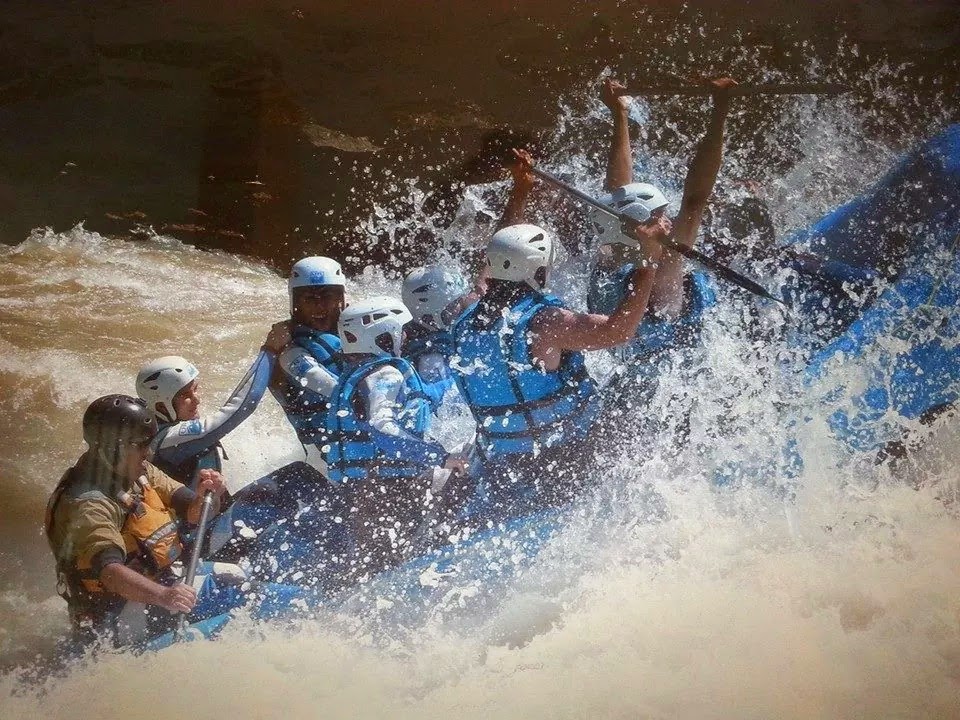
After visiting one of the most important and impressive historical sights in all of Europe, we embarked on a less intellectual adventure: rafting down the Gállego River! I'd never been rafting before, so at the beginning I as kind of nervous, but I ended up having so much fun. Also, there were some impressive red rock cliffs towering above us, so I got to navigate rapids and appreciate Spain's natural beauty at the same time.


After rafting, we returned to Zaragoza to get ready for the night. My friends and I found a super cheesy Grease-style American diner, and although the burgers weren't very good, we enjoyed the American decor and just hanging out on the Fourth of July. After dinner, we walked around a bit and enjoyed being in the city.

A portion of the group (Americans and Spanish siblings) on 4th of July
After such an exhausting day on Friday, we all slept in pretty late on Sunday. Around mid-morning I went to a giant, brand-new mall called Puerto Venecia with my host family. Afterwards, we came home for lunch and siesta, and then I went to the pool with Carla, my host sister, and two of my friends from the program, David and Daniel. Carla met up with her Spanish friends at the pool, so the three foreigners were on our own. We borrowed one of Carla's friend's ping pong paddles and walked over to the ping pong tables. We were just minding our own business when a giant pack of 12 year old Spanish boys came over and tried to take our paddles! After 10 minutes of harassment, we decided to walk away, but Jaime and co proceeded to follow us and didn't leave us alone for a while. So, I guess I can check getting swarmed by 12-year-olds off my to-do list.

Spanish boys trying to get us to trade paddles. Jaime, the pack leader, is in the red and white checked swimsuit.
We left the pool at around 9. Carla, David, Daniel and I walked to the Plaza del Pilar, got ham sandwiches (ham is super super popular here), and enjoyed seeing the Pilar all lit up at night. After eating, we noticed people were walking around in a fountain in the Plaza del Pilar, so we decided to join!

In the fountain in front of El Pilar
Today has been a pretty low key day as well, although this morning I finally got to try chocolate con churros! Carla, Natalia and I each got a coffee cup filled with thick dark chocolate, and then a plate of churros to share. The smaller ones are churros, and the bigger ones are called porra. They were delicious, although very filling!


¡Chocolate con churros!


That concludes my adventures from the past three days. I can't believe I'm about to begin my third week in Spain. These past two weeks have really flown by. I'm super excited for this week, because from Wednesday through Friday I will be in Madrid,and I'm super excited to visit the capital of Spain and see all its art, history, and culture!


Thursday, July 3, 2014

A Walk Through Time

Up until today, this week had been pretty slow. Each morning we have two hours of grammar (!), a half hour break, and two more hours of culture class. In the half hour break, my friends and I have discovered a tiny neighborhood on the backside of the building where school is. There are lots of great bakeries and cafés. This week we've discovered a café that we all loved right behind the school. My favorite drink so far has been the café con leche, and at this place they always draw a little design on top!


In culture class we have learned about the reign of Juan Carlos, the Spanish king who abdicated on June 18th, during which Spain became a parliamentary constitutional democracy. Also, we learned about the kings who ruled Spain in the time spanning from the Catholic Monarchs (Reyes Católicos) in the late 1400s to Charles IV in 1819. Although we talked about the history of Spanish government the majority of the time, we also learned a lot about the different stages of art in Spain, which is what I found especially interesting. Today, we walked around Zaragoza on an excursion to see some architectural examples of the Mudejar, Gothic, Renaissance, and Baroque styles.

First, we walked to the Patio de la Infanta, a courtyard built during the Spanish Renaissance in 1550. It was inside the residence of Gabriel Zaporta, a banker and merchant of Jewish ancestry who was also a borrower for King Carlos V. Today, it is strangely located inside of a bank tower (hard to believe, right?). If I wasn't here with SYA, it would have been impossible to find.


There are two styles of Renaissance art in Zaragoza: Plateresco and Purista. The Patio de la Infanta is very intricately and excessively adorned with medallions, and candelieris - all characteristics of the Plateresco style of Renaissance art. There were many medallions portraying kings of Spain, including Carlos I, the king at the time of its construction, and Fernando II de Aragón, the Catholic Monarch who united the kingdoms of Aragón and Castilla to form Spain through his marriage to Isabel I de Castilla.

Carlos I
Fernando II
After leaving the Patio de la Infanta, we walked to La Seo Cathedral. However, on the way we passed some pretty cool parts of Zaragoza. One was the Plaza de España, the center of Zaragoza. This is a picture of the Monument of Martyrs, which was completed in 1904 and is dedicated to the martyrs of Zaragoza. These martyrs are the Countless Martyrs of Zaragoza, who were 18 Christians killed by Roman persecutors in the 4th century, and the people who died defending Zaragoza against Napoleon Bonaparte's army in the Siege of Zaragoza in 1808-1809.

Monument of Martyrs
After passing the Plaza de España, we walked into another tiny neighborhood called El Tubo. The narrow streets of El Tubo are filled with restaurants and bars that all look like they have a great atmosphere. Also, I absolutely love the look and feel of El Tubo, so I hope I get to come back and spend more time there soon!


My culture class in El Tubo
Finally, we arrived at La Seo, Zaragoza's second cathedral (the other one is the Pilar). Zaragoza is the only city in all of Spain to have two cathedrals, as the church was very powerful here. It is built on the site of the old Roman Forum, and where La Seo currently stands there was originally a mosque during the Arabic control of Zaragoza until 1118. In 1121, the mosque was consecrated in the honor of San Salvador, and renovations were made to make it a better fit for Christian purposes. Then, in 1140, the mosque was demolished and construction on the cathedral began and continued throughout the 13th century. The lower part of two of the apses are preserved from this era in the current cathedral. In 1204, Pope Innocent III granted La Seo the privileges of being the site of the coronations of Aragonese kings, and all Aragones kings from that year until the 1400s were crowned there. Carlos I was the last king to be crowned in La Seo. In addition to coronations, royal weddings, baptisms, and burials took place there. Furthermore, the cathedral had various changed made and additions put on during the Renaissance era. Call me crazy, but I liked the interior of La Seo more than that of El Pilar. I could see the Mudejar, Gothic, Renaissance, and Boroque styles blending together in the various chapels and architectural details. One of the things I love about studying in Spain is that I can see the things I learn in the classroom around me in real life. Here are some pics of La Seo (the pics of the interior are not mine as there is no photography allowed inside):


Photo creds: https://www.flickr.com/photos/snuffy/6202384050/
You can see gothic elements on the top half of the altar and Renaissance elements in the scenes near the bottom half.
Photo creds: http://en.wikipedia.org/wiki/La_Seo_Cathedral#mediaviewer/File:La_Seo.jpg
The exterior side wall of La Seo was also really cool. It is one of the oldest parts of the cathedral, and is a prime example of Mudejar art. Mudejar art is a style of art created by Muslims who stayed in Spain after the Christian reconquest. It is a blend of Islam and Christianity, and the geometric and colorful designs on the side of La Seo are very typical of Mudejar art:


This tower also has very gothic designs in the windows.

Well, looking back and seeing how long this post is, I think that its incredible that I saw all this history in two hours without walking more than 20 minutes away from school. As I said before, the beauty of studying abroad is being able to see what I learn in the classroom come to life on the streets. I can't believe how much I've learned just by walking around.

Tomorrow, we will be taking an all-day excursion and afterwards my friends and I will be eating dinner together with our host siblings to celebrate the Fourth. All of us Americans are pretty excited to show our pride tomorrow, so watch for a new post about hiking, castles, river rafting, and how to find the best American restaurant in Zaragoza!